

David Candaux Unveils DC6 Night Forest in UD Carbon and Titanium
Two materials. One design. Nothing superfluous
PRESS RELEASE | 2006 WORDS | 15 MINUTE READ
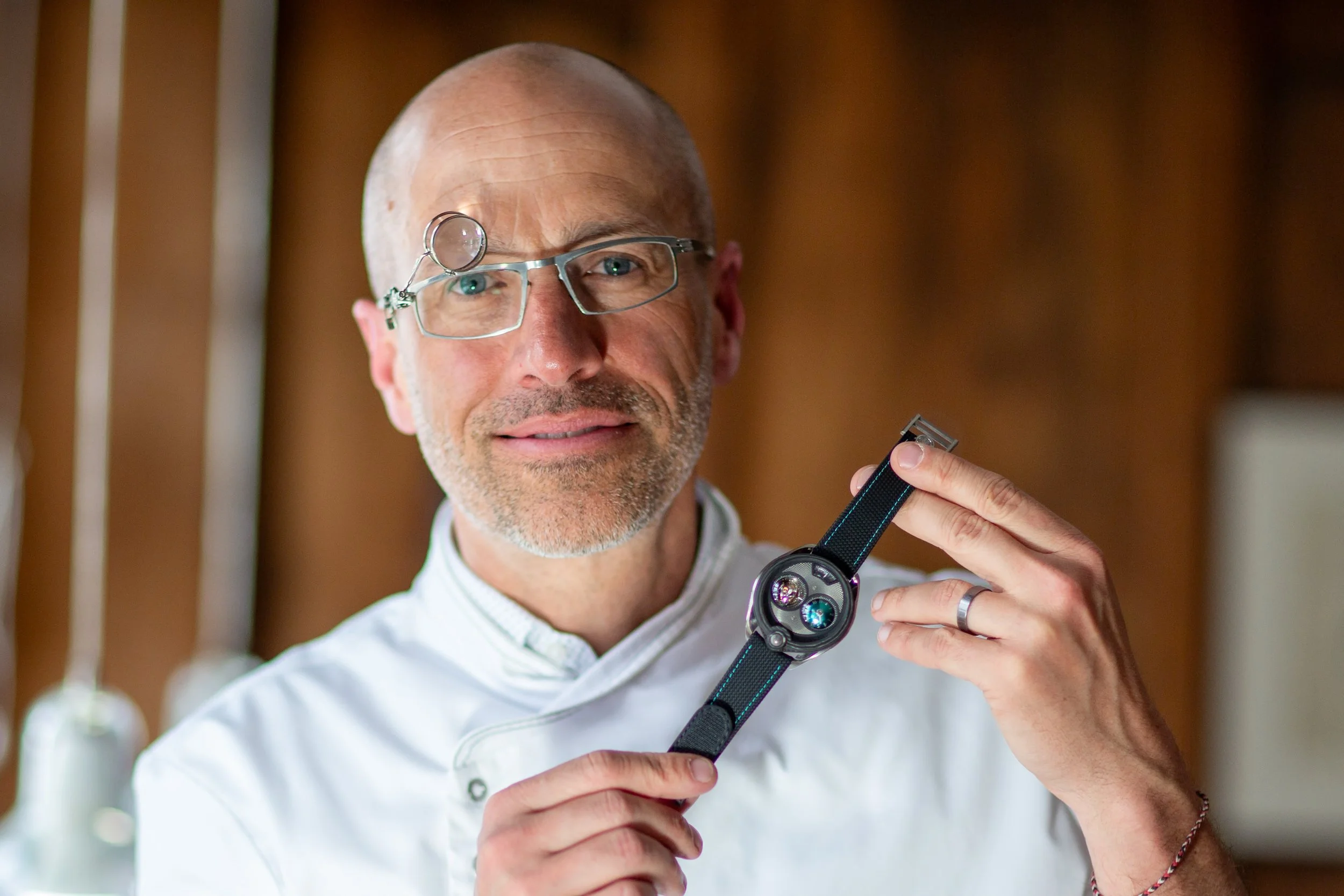
Photo Courtesy: David Candaux
The DC6 naturally calls for carbon. A contemporary watch, designed for everyday wear, made for a life on the move. The material speaks for itself in this collection.
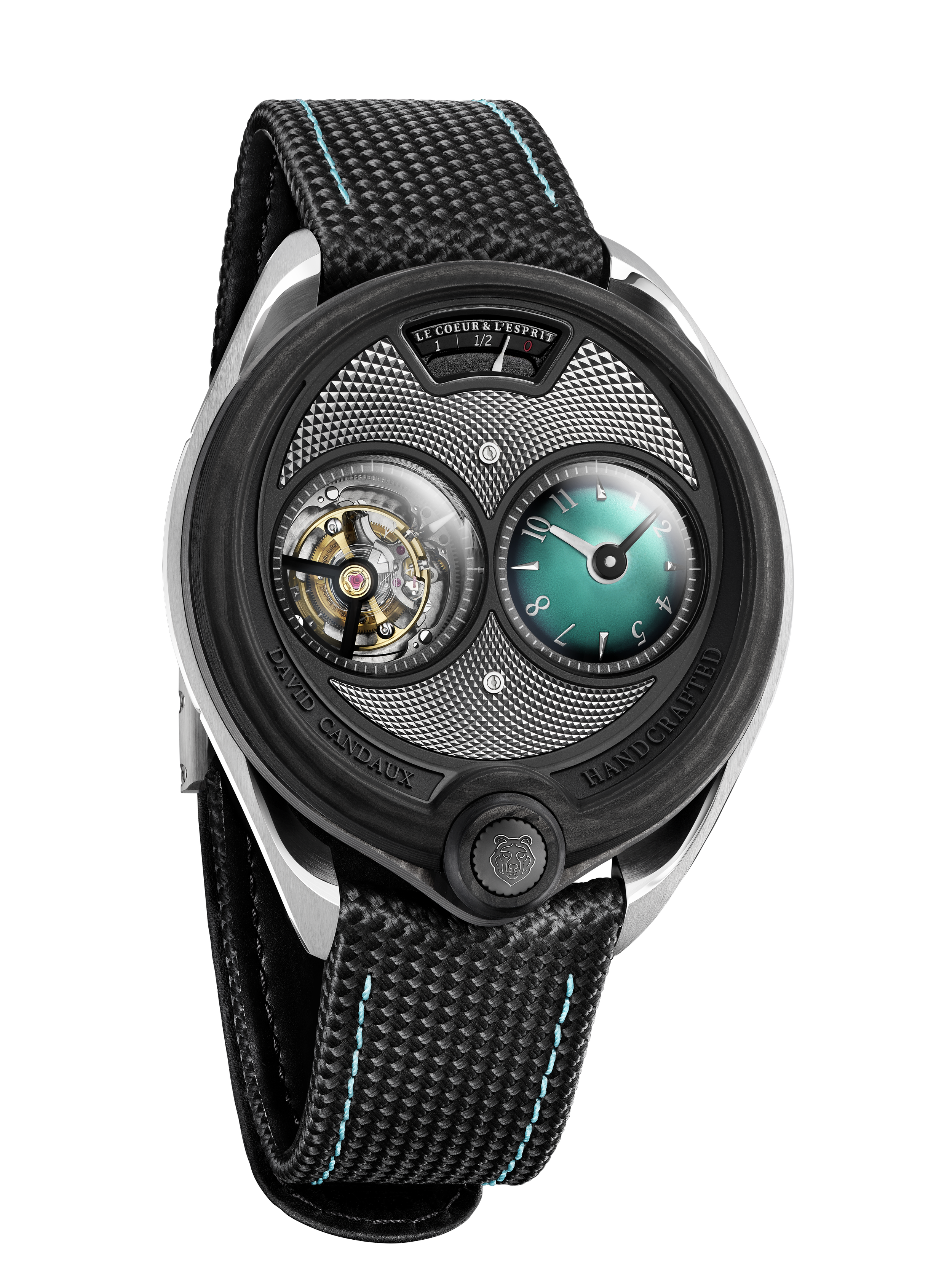
Following an initial version in forged carbon, which quickly found its audience, David Candaux continued to explore the potential of this material. The result: a timepiece in UD carbon and natural titanium, featuring a smoky topaz green dial. The lightest piece in the collection: 45 grams on the wrist. Water-resistant to 50 meters. Produced in a limited edition of eight pieces.
From forged carbon to UD carbon: the right material
Forged carbon is all about the shavings. Fragments of carbon fibers embedded in epoxy resin, compressed under heat and pressure. The result has presence. The speckled surface catches the light in unpredictable ways. But the structure carries its own weakness: random fibers, a resin acting as a binder, and a binder that eventually gives way. Under prolonged stress, at the edges, or under impact, forged carbon disintegrates. The resin matrix cracks deeply. The chips peel away, slowly, insidiously.
UD carbon, short for unidirectional, is based on a different logic entirely. No flakes, but sheets of continuous fibers. The fibers run through the entire thickness of the material, without interruption. The resin is present, but secondary. Less abundant, better distributed, structurally marginal. Under impact, force travels along the fibers rather than concentrating at the resin-flake interfaces. The material is homogeneous, mechanically coherent, and significantly more resistant to delamination. Precisely what DC6 demands, in terms of both durability and aesthetics.
Where forged carbon appears speckled and random, UD carbon reveals itself as veined, striated, and directional. This is not an esthetic decision. It is the direct result of the internal structure: ultra-thin 30-micron plies stacked with precision; each rotated 45° relative to the previous one. When light glances off the surface, it reveals these successive rotations as regular undulations. The same phenomenon that gives the grain of aged wood its depth and direction.
Combined with titanium, UD carbon gives the watch a virtually eternal lifespan. The right materials have been placed in the right places, based on external stresses and to best protect the movement. UD carbon does not scratch easily. It does not disintegrate. It does not develop a patina. In twenty years, the case will be exactly as it is today.
Architecture: titanium DRESSED in carbon
Carbon is porous. This is a physical reality. The case design takes this into account.
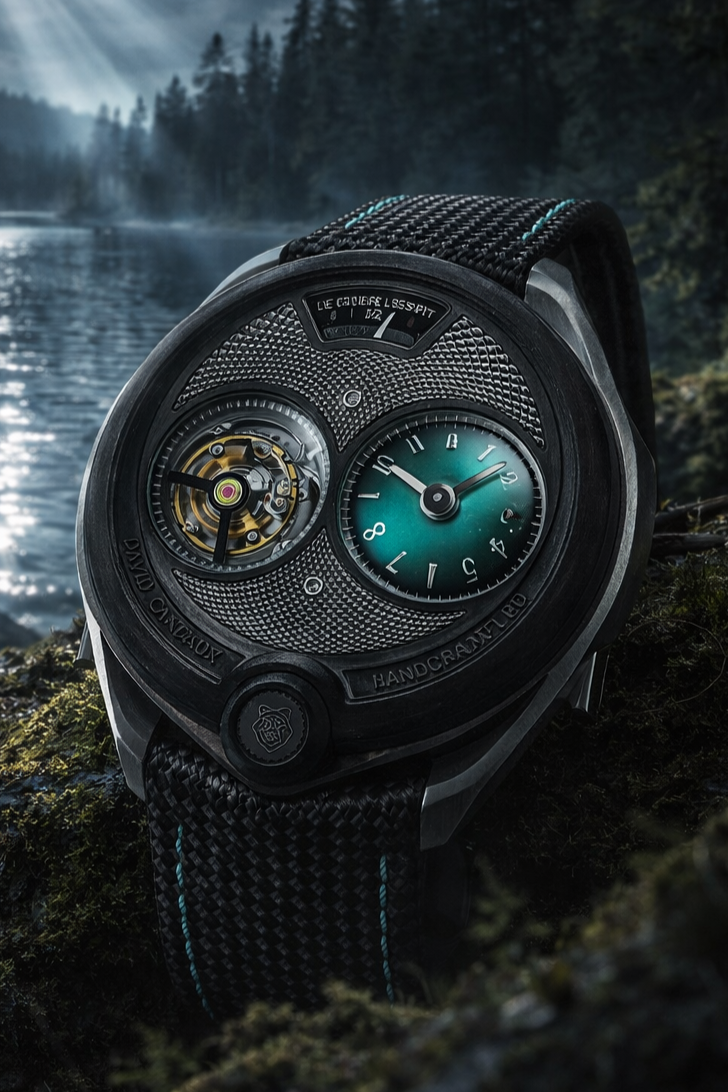
The movement is housed in a titanium chamber that ensures water resistance. This chamber is then clad: the case band and bezel are made of UD carbon, all held together by titanium stretchers that run the full length of the case and extend naturally into the lugs. No adhesives. A fully mechanical assembly for an aesthetically pleasing timepiece, 45mm in diameter, water-resistant to 50 meters. A DC6 that weighs 45 grams, robust and built to last.
On the dial, the hand-finished natural guilloché titanium plates, the DC6’s signature since its inception, are framed by a titanium ring coated in black PVD. A play of volumes, materials, and depths. The titanium “Magic Crown” is also capped in carbon.
Black titanium: a surface, not a coating
In traditional watchmaking, bluing steel is not a surface coating, but a transformation. The steel is heated to the right temperature, around 300 degrees, and the iron oxidizes naturally. An oxide layer forms, integral to the metal itself, with its thickness determining the color: first straw yellow, then violet, until it reaches that deep blue that watchmakers have sought for centuries. Nothing is applied to the steel. It is transformed by heat, from the inside out.
Titanium anodization follows the same principle, with electricity replacing heat. The component is immersed in an electrolytic bath and subjected to a controlled current. Voltage drives the oxidation: a layer of titanium dioxide (TiO2) forms from within the metal's own surface rather than over it. Each voltage threshold produces a specific oxide thickness, and each thickness produces a specific colour. Bronze, purple, blue, turquoise, green: as many shades, as many precise voltages.
Black is another matter.
The TiO₂ layer is optically transparent. It does not absorb light. It interacts with it through interference, like oil on water. Yet interference cannot produce black. The spectrum of standard anodization runs through the visible colors as the voltage rises, but black is not part of it. Worse still: before reaching it, the oxide layer hits its dielectric breakdown threshold. Electric arcs form on the surface, degrading its quality and roughening the titanium. This roughness is precisely what must be avoided.
Black is achieved through micro-arc oxidation: localised plasma discharges transform the surface into a dense ceramic layer, integrated into the metal. This layer absorbs light rather than refracting it. The result is bonded to the titanium, does not flake off, and the surface retains its original finish.
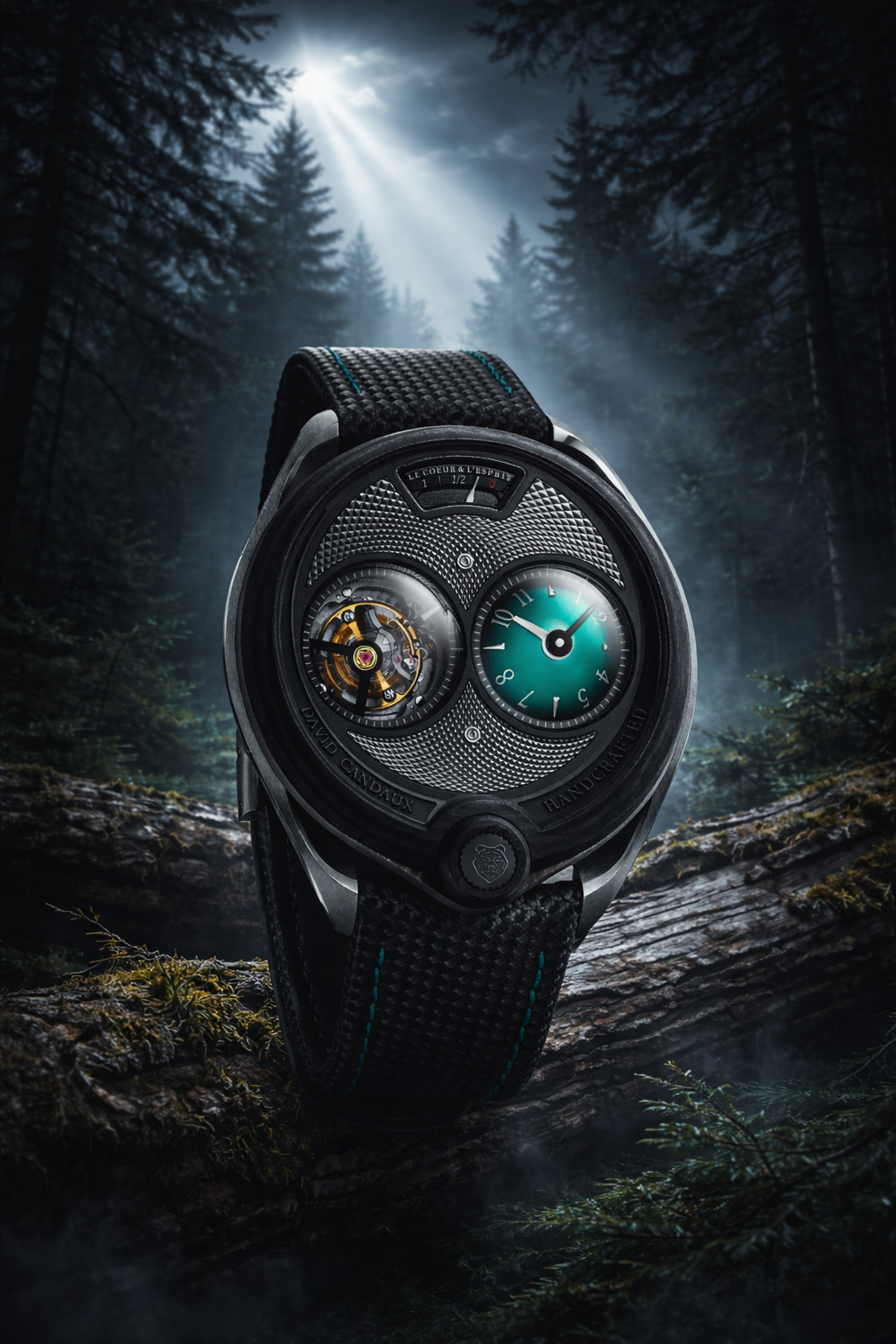
Transformed this way, without any coating, PVD, or DLC, the tourbillon cage of the DC6 Night Forest is an intense black, without losing its mechanical properties. In a category where black is almost always achieved through galvanic processes or coating, this distinction is technical. In a hundred years, the tourbillon cage will be exactly as it is today.
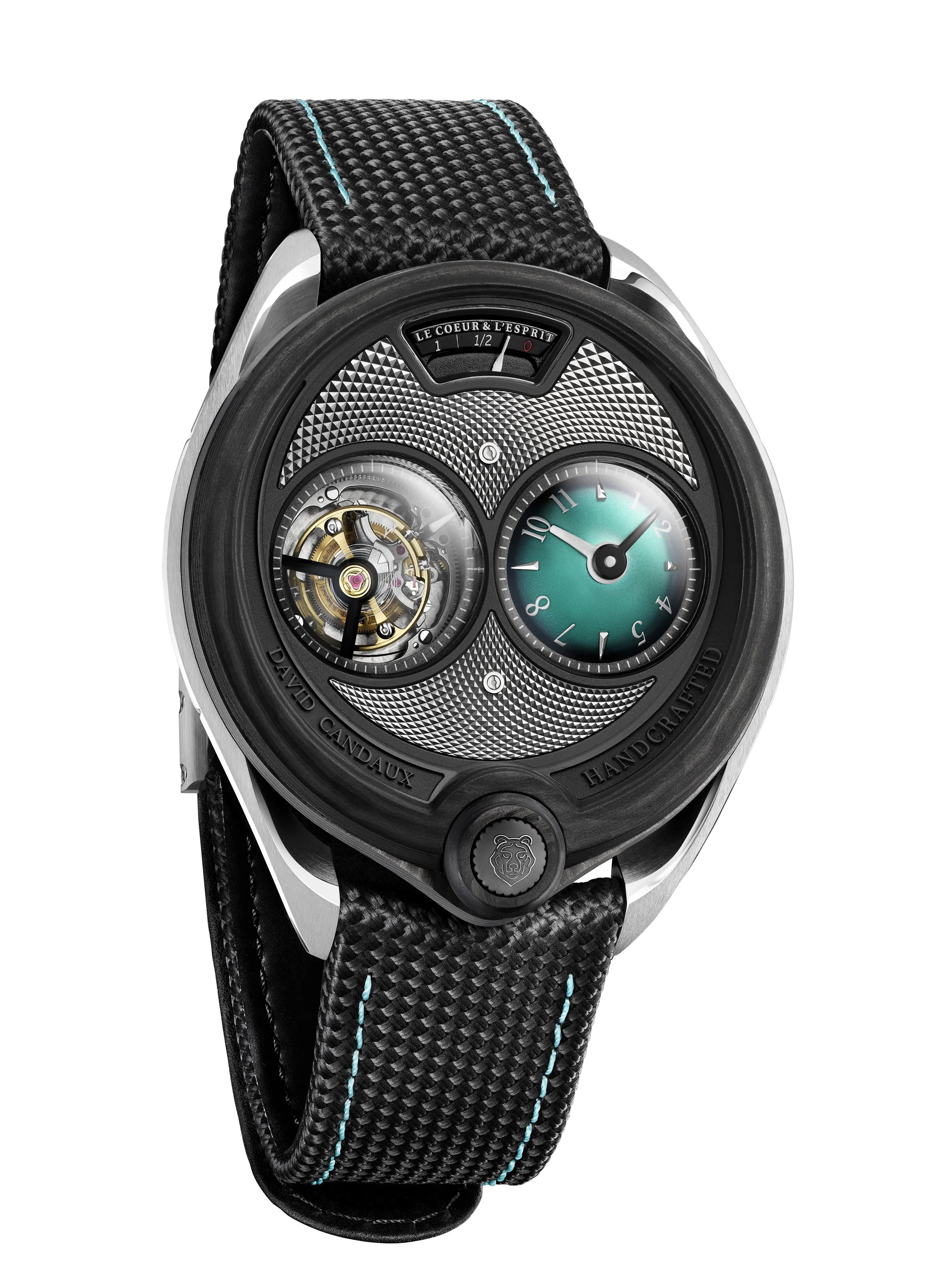
The Dial: A smoky topaz green built on illusion
The dial is domed, a design dictated by the movement’s architecture. It is on this surface that the first secret unfolds: a hand-applied sunburst finish, whose striations radiate from the center toward the edges. Light does not reflect uniformly; it shifts with the wrist. Next comes the anodization. The same physical principle as for the tourbillon cage, but in a standard process, without plasma discharge. The voltage is pushed to the limits of the accessible spectrum to achieve this topaz green reminiscent of mountain lakes on a clear day.
A transparent lacquer is then applied over the entire surface. It does not alter the color. It resonates with the sunburst pattern beneath, amplifying the reflections and adding the depth that anodization alone cannot produce.
The smoky effect, however, is an illusion. The curved surface prevents any direct gradient on the dial. The solution: a simple translucent black circle applied to the base, created by hand using an airbrush. The eye does the rest. It interprets this dark edge as depth, a gradual darkening toward the edges. The gradient does not exist. It is merely suggested. To heighten the illusion, the numerals and hour markers are crafted from silver powder using a decal technique, with layers of material. They appear to float within the depth of the dial. The black-gold minute track at the base completes this spatial composition: it anchors the eye along the perimeter, reinforces the impression of depth, and transforms the dial into an object that shifts with every movement of the wrist.
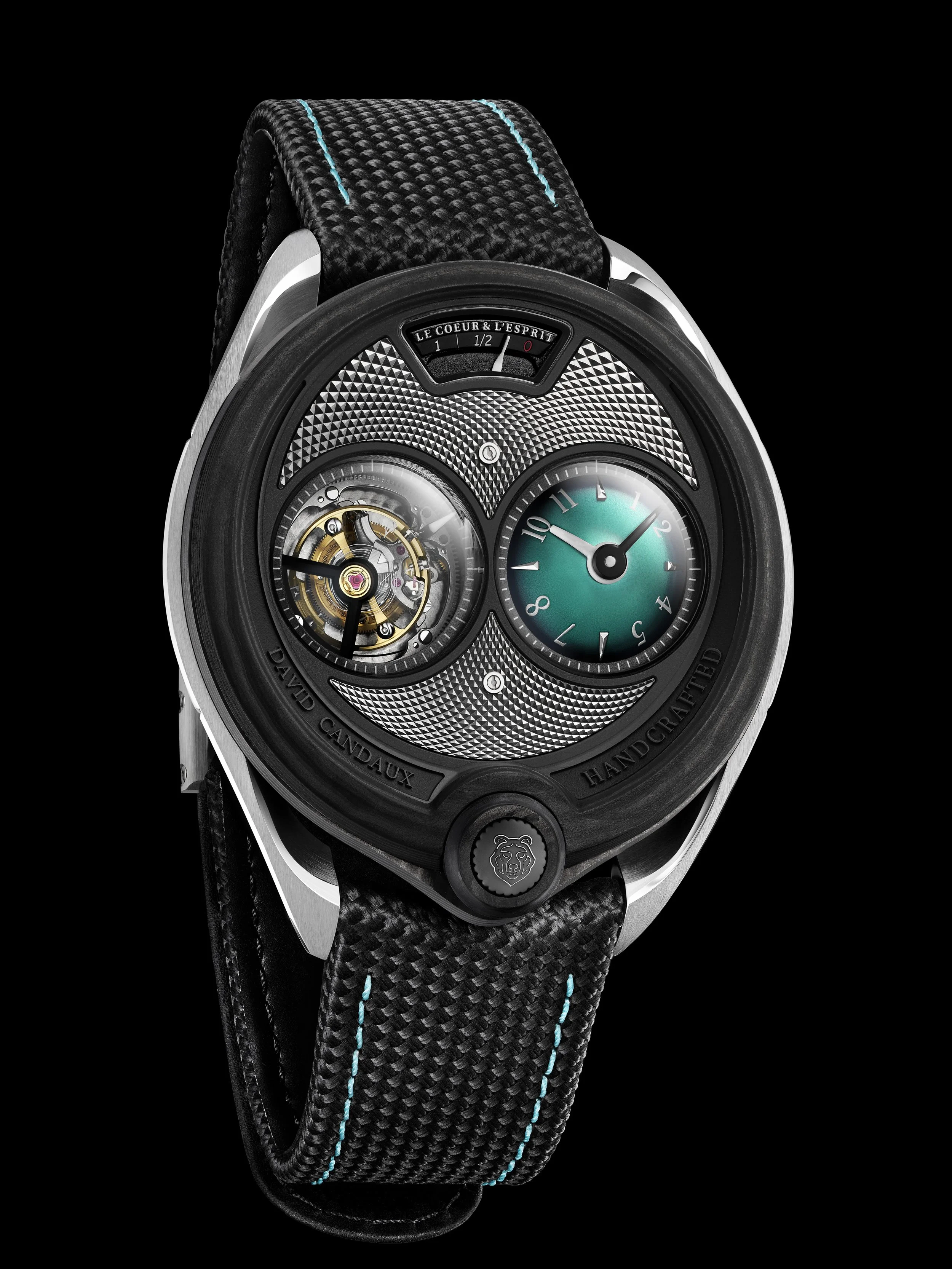
Sensory Experience: Four Textures, One Dialogue
The DC6 Night Forest is read as much with the hands as with the eyes. The DC6 already stood out for its tactile dimension. The Pointes du Risoux guilloché pattern, hand-executed on titanium using in-house expertise developed to achieve a perfect finish on every motif, can be felt under the finger as much as it can be seen. The sapphire domes draw the eye into the movement. This sensory architecture remains intact in the Night Forest. We find titanium in the side lugs: bare metal, sharp edges, cold to the touch. Then there is UD carbon: a different material, a different register. Neither cold nor polished. Silky is the most accurate word. A surface that the hand perceives as warm, textured, immediate. The “Magic Crown”, made of titanium, is topped with carbon. The transition between the two, under the fingertip, is deliberate. Two materials in harmony, complementing one another.
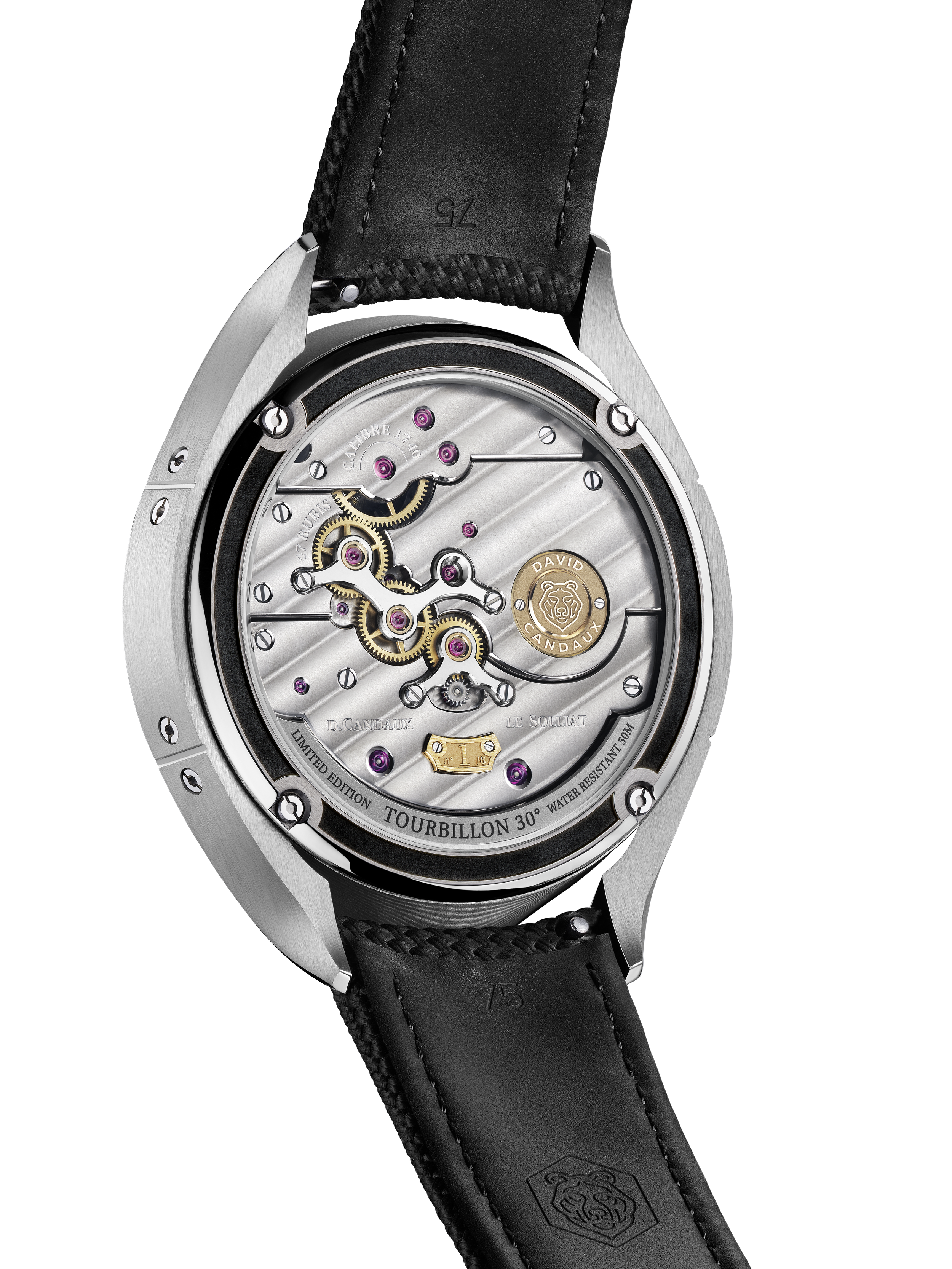
The H74 Caliber
The H74 is developed entirely in-house at Le Solliat. Bridges and mainplate in Grade 5 titanium, chosen for its natural properties. Corrosion-resistant. Anti-magnetic. Thermally stable. Lightweight. Biocompatible. David Candaux remains the only watchmaker to have implemented this approach across all his movements.
The wheels are made of beryllium copper (CuBe). The axles, pinions, pins, and screws are made of stainless steel. Each component is crafted and finished by hand, in keeping with the savoir-faire passed down in the Valley since 1740. At the heart of the movement: the flying tourbillon inclined at 30°, completing a revolution in 60 seconds. The inclination serves a mechanical purpose. A wristwatch constantly passes through different positions. The 30° tourbillon processes a greater number of them in less time. A real chronometric advantage, on the wrist. The small seconds hand is directly integrated into the cage.
The sapphire case back reveals the movement. The cascading bridges, inclined at 3° relative to the case, create a depth effect that shifts with the light. Eighteen curved recessed angles, each mirror-polished by hand. Straight graining, polished bevels, and pearling beneath the bridges. Power reserve: 55 hours, indicated by a hand at 12 o’clock. The motto “Le Cœur et l’Esprit” is inscribed on the indicator. Frequency: 21,600 vibrations per hour. Phillips terminal curve balance spring. Variable-inertia balance wheel with gold adjustment screws.
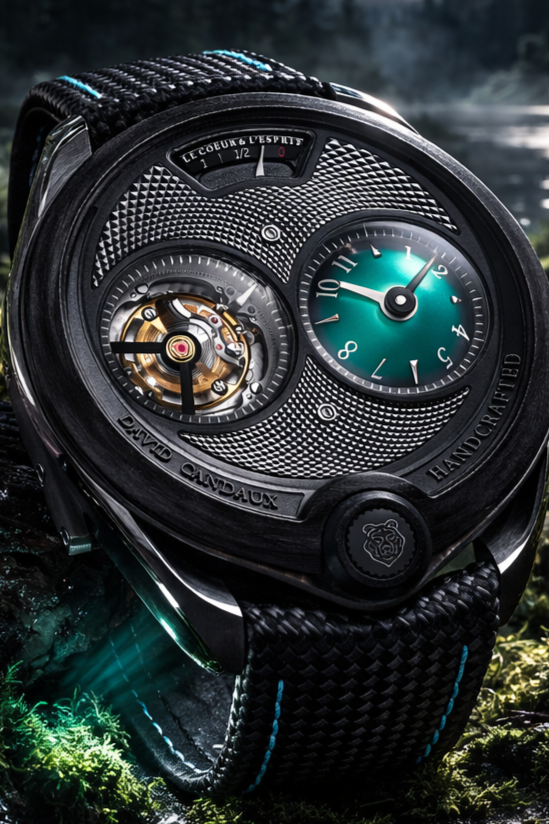
The “Magic Crown”
Every watch from the David Candaux maison is based on the same visual tension: horizontal symmetry, vertical asymmetry. The balance that Leonardo da Vinci articulated in the Vitruvian Man: natural, pleasing to the eye and faithful to the body’s proportions. To achieve this, the conventional crown at 3 o’clock had to disappear. The solution draws on the retractable ballpoint pen and its bistable cam: one press to deploy, one press to retract. Simplicity. Robustness.
David Candaux developed its own version, tested 28,000 times, equivalent to four presses a day for twenty years, with no measurable wear. The result is a patent: 31 components that condition the entire architecture of the case and movement. The “Magic Crown” at 6 o’clock is the hallmark of every model in the brand’s collection. Three positions: winding, time setting, neutral. When not in use, it disappears into the case. The watch is adjusted on the wrist with a natural gesture. Water-resistant to 50 meters in all positions.
Contemporary. Mechanical. Essential.
Carbon in this form belongs to aerospace structures, Formula 1 monocoques, and machines engineered to be both lightweight and sturdy. A vocabulary of performance. David Candaux brings it to the wrist with the same logic: a watch for a life in motion, for those who don’t want to feel the weight of what they’re wearing. But the veined surface of the UD carbon pulls the piece toward nature. It is not the bark; it is the heart of the wood. The same veins, the same lines that run and intersect, the same underlying order found in the trees of Risoux. The most technical material in this watch is also the one that creates the most direct link to the forest. This duality, mechanical and natural, contemporary and rooted, is the realm in which David Candaux works. It is also, at its core, what the Vallée de Joux has always been: a place where the workshop and the forest face each other.
About David Candaux
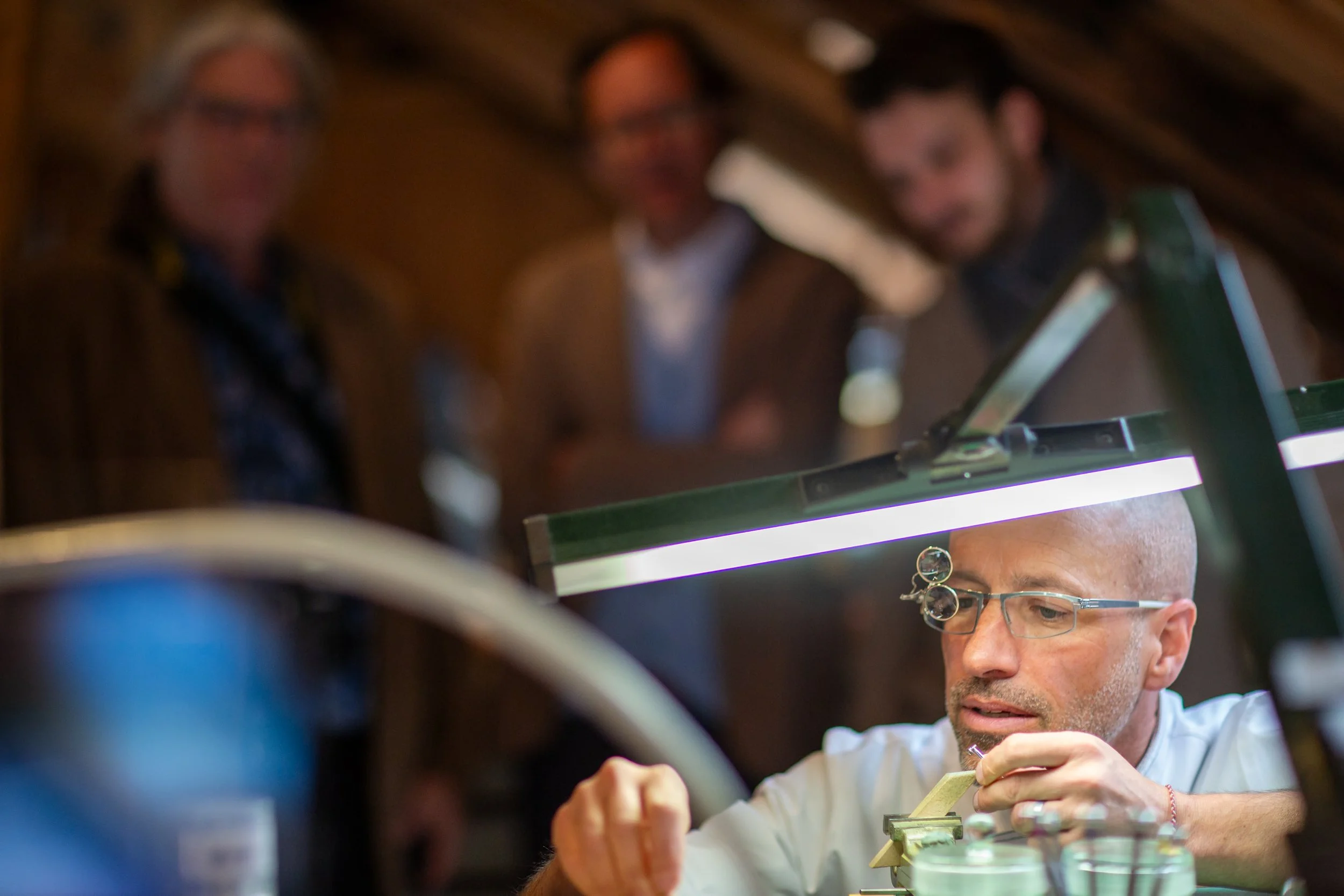
David Candaux, an independent Swiss watchmaker and engineer, embodies horological excellence through his eponymous brand, founded in 2017. A native of Vallée de Joux, the cradle of Swiss watchmaking, he stands out for his boundless creativity, singular inventiveness, and exceptional craftsmanship. Based in Le Solliat, his workshop is a hub of creativity and technical innovation, producing watches renowned for the complexity of their mechanisms, their precision, and their unique aesthetics. His commitment to the art of watchmaking is evident in every piece, designed from start to finish with passion, featuring patents that enrich 21st-century watchmaking while perpetuating the legacy of the Valley’s masters. An iconic figure in contemporary independent watchmaking, David Candaux designs watches that speak to the Heart and the Mind.
Availability
The DC6 Night Forest by David Candaux is available through the official website.
For further information, visit: https://go.davidcandaux.com/
